Proposal: Designing a Green Space
Issue: There is a plot of land on campus that is not being utilized and the current practices to maintain it are harmful to the environment.
Approach: Collaboratively create a landscaping design by using plant guilds
Genre: Physical Installment
Strategy: Collaborate with classmates on ideas for the design and function of the space and create a blueprint that may be implemented at some point in the near future
Who: Myself and my class mates
What: A Collaborative Green Space Design
Where: During class and in my free time
When: During class and in my free time
Why: We are creating this design with the hopes that in the future these designs will be used to help construct a space that will be utilized and improve the environmental health of a space that is currently being neglected and used in an environmentally harmful way.
How:
- Come up with my own idea for a design
- Research plant guilds
- Draft design idea
- Share designs
- Share ideas and skills in class
- Collaborate
- Form groups off of skills and ideas
- Work on final draft together
- Document
- Post research
- Final design
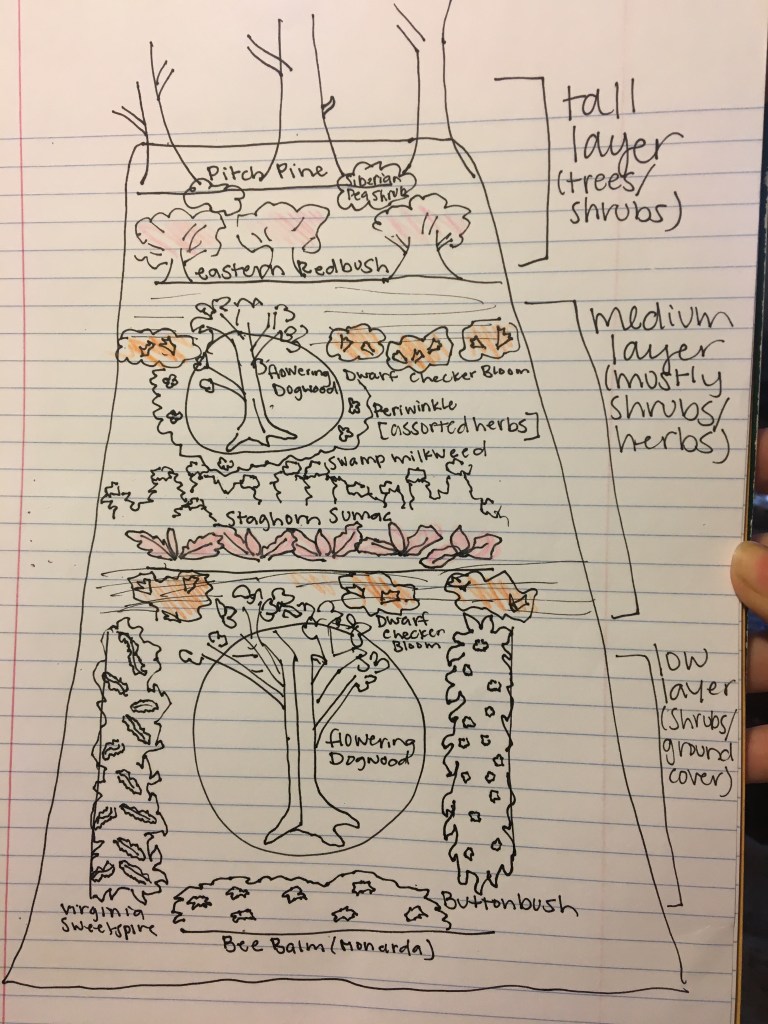
I want to integrate “2050” into my design because that is the year the GMU has pled it will be carbon neutral by. To represent this: “2” I used two types of taller plants (a tree -pitch pine- and a tall scrub -eastern reddish-. The “0”s are dogwood trees, Virginia’s state tree and since we are the largest state school, it felt a little extra symbolic. The “5” is represented by medium-large scrubs (Buttonbush, Virginia Sweet spire, Bee Balm, Staghorn Sumac, and Dwarf Checker Bloom). The other plants in this design were included because of their symbiotic relation to other plants or because they provide a specific funcation that this plot of land needs.
Art Discussion
Mushroom Burial Suit
I have wanted to be buried non-“traditionally” after I did some research a few years ago on the environmental impacts of burial and cremation practices in the United States. I have heard of methods using composted remains to provide soil for tree saplings but I never thought about how those bodies would be decomposed, especially when our bodies have such high levels of toxins. On a spiritual level, I feel that it is important for us to return and be used by the environment that sustained our existence. This is an extremely exciting endeavor and I hope that it brings people closer to accepting death and our death’s role in environmental health.
Reclamation Project
This EcoArt project engages individuals in reclaiming spaces that have been degraded and restoring them. This Project actively engages with the community to educate and involve the public in environmental adaptation projects that will improve the environmental health of these communities. So, in a way, they are not only reclaiming space for environmental growth but they are also reclaiming a social space for their social community. This project reminds me of my first project in this class, my “Inner to Environmental Growth” Garden. Through that experience, I found that it is incredibly fulfilling to integrate community when creating a space for ecological and personal growth.
800 Steps Away
After the collapse of the World Trade Centers, many human health hazards were released into the air. Even though the dust settled, many residents were unknowingly contaminated. Although the circumstances are different, this documentary reminds me of the Flint water crisis because so many knowing citizens were exposed to toxic and hazardous pollutants. In both cases, people are experiencing devastation health effects and the government is still not being proactive or transparent about data collection and dissemination surrounding these community’s concerns. The more I listen to the document, the more it reminds me of the uncommon story of environmental racism in our country. I can’t assert with confidence that this is the case here, but there are eerie parallels.
Text Discussion: Gaia’s Garden
Capturing, Conserving, and Using Water
The capturing section of this portion of the text goes into various ways in which we can promote more water absorption in the soil and how to integrate these practices when designing a green space. The piece that I found most interesting is the method of using plants that high a high absorption rate in their root system as a strategy for holding water in the soil. This combined with the soil contouring concept is an interesting way to begin to inform the physical design of a green space. Reading the section of water catchment was really interesting but unfortunately, some local laws in the US still prevent people from taking advantage of this practice. I have always known that the water system is a cycle but the Graywater section reinforced the fact that we can recycle/repurpose “used” water to create a closed and sustainable water system. This section, combined with the section on backyard wetlands allowed me to reflect on the potential of human terra-engineering.
Multipurpose Plants
I have known that plants can serve a myriad of purposes, not only for humans but for the environment. The make-up of soil can be completely altered (whether the quality is enhanced or degraded) by the types of plants that are grown there. One category of plants that improve soil quality is “nitrogen-fixing” plants. These plants are typically legumes. They can be used as a form of medicine or poison. What stood out to me most about this section was the motif of dichotomy. For every characteristic one plant may have, there is a counter-characteristic that another plant has. The natural world has a way of creating the opportunity for balance at every turn.
Guiding the Garden
While learning about all the varying characteristics of plants and how they relate to their environment reminded me of organizing in activism spaces (in the Multipurpose plants section). To organize well and ensure that your movement reaching tangible goals, you must know how to work with a large group and delegate tasks to those who would be best at that job. Organizing a green space similar to this. It is important to look at the environmental design from a bird’s eye view to get an idea of what the desired goal is but, in order to execute this goal, you must look at relationships and characteristics with a deep level of attention on a highly focused scale. Both the macro and micro levels inform one another and are both essential to having a successful level of balance and efficiency in one’s organization and design.
Designing Garden Guilds and Growing a Food Forest
These sections remind me of the time I spent in the Madre de Dios region of the Amazon headwinds in Peru. We implemented a type of permaculture called, agroforestry. Through research and trial/error, we were able to arrange plants, physical structures, and wildlife attractors in a way that mimicked the natural design of the forest and thus, provided us with the natural benefit of agriculture. Every action we took in the agroforest had stacking functions and a specific intention that it would positively benefit the micro-ecosystem that we built within one of the largest ecosystems in the world. It was refreshing to be reintroduced to these concepts again but this time in a slightly different context and strategy of execution. In the agroforest, the purpose of the guild building was primarily for human consumption (food) whereas Gia’s Garden expands on this concept to include the way that we arrange and care for the plants around us for a myriad of other purposes. What is most interesting and impactful to me about plant guilds is the fact that they are entirely based on natural relationships and our ability as humans to derive and support those relational connections in nature. I continue to be impressed and mystified by the fact that our natural world mirrors the emotional world of humans.

